
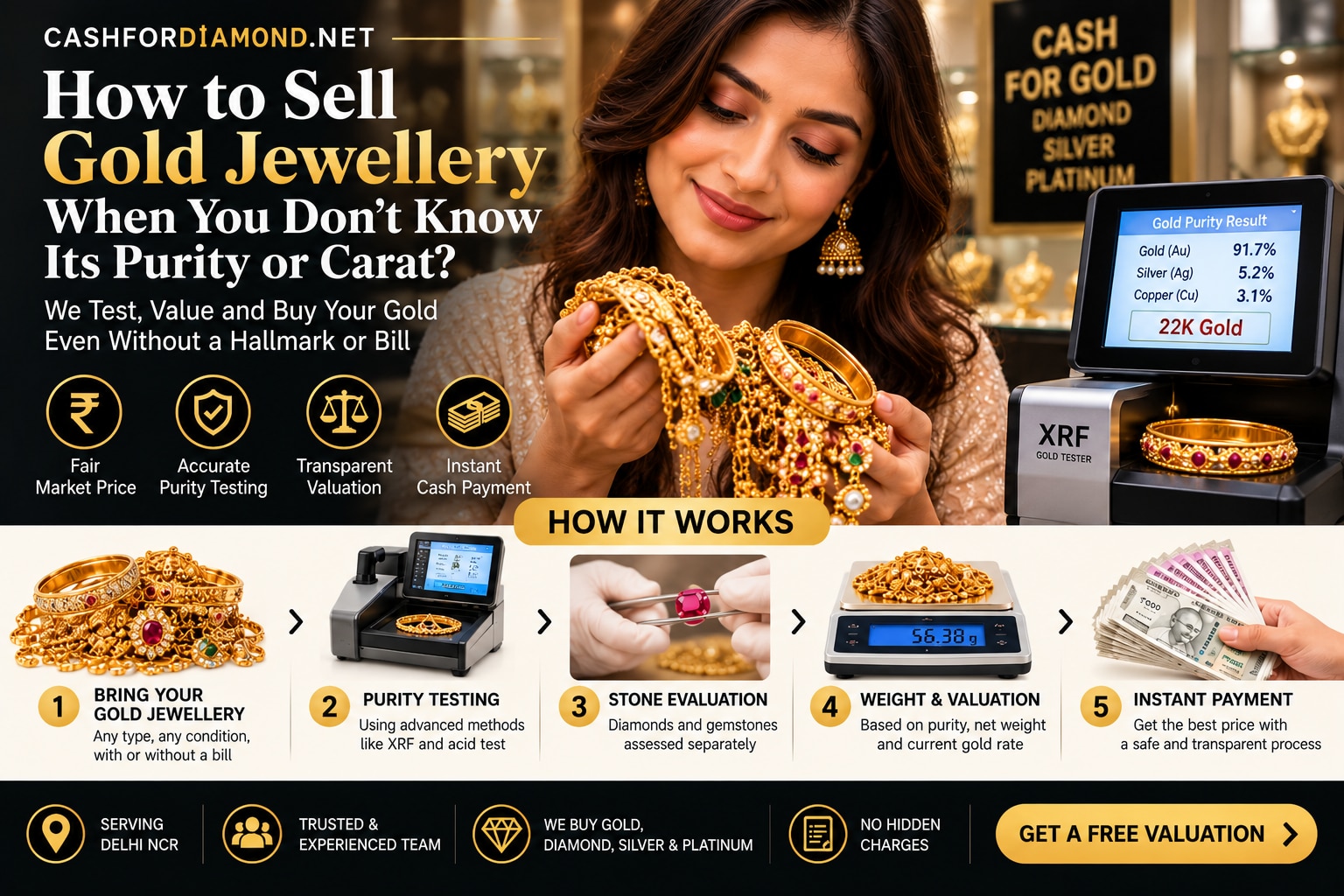
How to Sell Gold Jewellery When You Don't Know Its Purity or Carat?
Do you have old gold jewellery at home but don't know whether it is 18K, 22K or 24K? Perhaps the jewellery was purchased many years ago, inherited from family members or received as a gift. You may have misplaced the original bill or forgotten its purity details.
The good news is that you do not necessarily need to know the exact carat or purity before approaching a gold buyer.
Gold purity can be assessed through suitable testing methods, helping determine the actual gold content and estimate its resale value.
If you are planning to sell gold jewellery without knowing its purity in Delhi, this guide explains how the process works, how gold is tested and what you should check before selling.
1. Can You Sell Gold Jewellery Without Knowing Its Purity?
Yes, you can enquire about selling gold jewellery even if you do not know its purity or carat.
Gold buyers can assess jewellery to determine its approximate or verified gold content, depending on the testing method used.
You can enquire about selling:
Old gold necklaces and chains.
Gold bangles and bracelets.
Gold rings and earrings.
Broken or damaged gold jewellery.
Inherited family jewellery.
Gold jewellery without original bills.
Old ornaments with faded or missing purity markings.
You do not need to identify whether your jewellery is 18K, 22K or 24K yourself. A suitable purity test can help establish its gold content.
2. What Do 18K, 22K and 24K Gold Mean?
Gold purity is commonly expressed in karats (K). The karat system indicates how much pure gold is present in an alloy.
Here is a simple explanation:
24K Gold: Approximately 99.9% pure gold. It is commonly used for investment products such as gold coins and bars.
22K Gold: Approximately 91.6% pure gold. It is widely used for traditional Indian gold jewellery.
18K Gold: 75% pure gold. It is commonly used in diamond and gemstone jewellery.
14K Gold: Approximately 58.5% pure gold. It is also used in jewellery manufacturing.
The remaining percentage consists of other metals that provide strength, durability or different colour characteristics.
Knowing the karat is important because the gold content directly affects the estimated resale value.
3.How Can You Check Gold Purity Without Knowing the Carat?
If you do not know the purity of your jewellery, a gold buyer may use different testing methods to assess it.
A. XRF Gold Testing
X-ray fluorescence (XRF) is a non-destructive testing method used to analyse the elemental composition of gold.
It can help identify the approximate percentage of gold and other metals present in the tested area.
Advantages include:
Does not normally require melting the jewellery.
Can provide a quick composition analysis.
Helps identify different gold purity levels.
Can be used on many types of jewellery.
However, XRF generally analyses the surface. Plating, coatings and variations within the jewellery can affect the result.
B. Touchstone and Acid Testing
This traditional method involves rubbing the gold item against a testing stone and applying suitable testing solutions.
The reaction is compared with reference samples to estimate the gold purity.
It is a useful screening method, although results depend on the testing technique and may not represent the entire item.
C. Laboratory Testing
Laboratory analysis may be used when more detailed or representative composition testing is required.
The appropriate method depends on the jewellery, the purpose of testing and the level of accuracy needed.
4. What If Your Gold Jewellery Has No Hallmark or Purity Stamp?
Many people own old gold jewellery without a visible hallmark or karat marking.
This may happen because the jewellery was purchased many years ago, manufactured by a local jeweller or inherited from family members.
A missing hallmark does not automatically mean that the jewellery cannot be evaluated.
A buyer may assess the actual metal composition through suitable testing methods.
Before selling, ask the buyer how purity will be verified and whether the test can be performed without damaging your jewellery.
5. How Is the Value of Gold Calculated If You Don't Know Its Purity?
The value of gold jewellery depends mainly on its verified purity, net gold weight and the applicable gold rate.
The general calculation is:
Estimated Gold Value = Net Gold Weight × Applicable Gold Rate × Purity Percentage
For example, consider two gold chains weighing 20 grams each.
One may be 22K gold, while the other may be 18K gold. Although their total weights are identical, their pure gold content is different.
Therefore, their estimated gold values will also differ.
Other factors that may affect the final offer include:
Actual purity testing results.
Net gold weight.
Stones and other non-gold components.
Applicable testing or processing charges.
Buyer's valuation and transaction terms.
Always ask for a clear explanation of the calculation before accepting an offer.
6. Can You Sell Gold Without an Original Purchase Bill?
Yes, some buyers may accept old gold jewellery even if the original purchase invoice is unavailable.
This is particularly relevant for inherited jewellery, old family ornaments and jewellery purchased many years ago.
However, the buyer may require identity documents, ownership verification or other paperwork depending on the transaction and applicable requirements.
Before visiting, ask whether the buyer accepts jewellery without an original bill and what documents are needed.
7. What If Your Gold Jewellery Contains Diamonds or Gemstones?
If your jewellery contains diamonds, rubies, emeralds, pearls or other stones, its total weight will not represent the net gold weight.
For example, a diamond necklace weighing 30 grams may contain considerably less than 30 grams of gold.
The buyer may need to assess the gold and stones separately.
Before proceeding, ask:
Will the stones be valued separately?
Is stone removal necessary?
Will removed stones be returned if they are not purchased?
Is the offer based only on gold content?
Are any testing or removal charges applicable?
For valuable diamond or gemstone jewellery, consider obtaining a separate assessment before accepting a gold-only valuation.
8. Important Things to Check Before Selling Gold of Unknown Purity
Before selling your jewellery, keep these points in mind:
Check the testing method: Ask whether the buyer uses XRF, acid testing or another method.
Confirm the weight: Make sure the jewellery is weighed transparently.
Understand the purity result: Ask for the tested gold percentage or karat.
Ask about deductions: Understand all applicable charges before accepting the offer.
Compare quotations: Approach more than one buyer to understand the available offers.
Check payment terms: Confirm the payment method and transaction documentation.
Protect your jewellery: Do not agree to melting or dismantling without understanding the process and giving your consent.
9. How to Choose a Reliable Gold Buyer in Delhi
If you are searching for gold buyers in Delhi, choose a business that follows a transparent valuation process.
Look for a buyer who:
Explains gold purity testing clearly.
Checks weight in front of you.
Shares the calculation used for valuation.
Explains applicable deductions in advance.
Handles jewellery containing stones carefully.
Provides clear payment and transaction details.
A transparent process helps you understand the actual value of your jewellery before selling it.
Frequently Asked Questions (FAQs)
Q1. Can I sell gold jewellery if I don't know whether it is 18K or 22K?
Yes. You can approach a gold buyer who can assess the jewellery using suitable purity testing methods.
Q2. Can a gold buyer identify purity without a hallmark?
Yes. Testing methods such as XRF and touchstone testing can help assess gold purity even when a hallmark is missing.
Q3. Is XRF testing safe for gold jewellery?
XRF is generally a non-destructive testing method and does not normally require melting or damaging the jewellery.
Q4. Can I sell gold without an original bill?
Some buyers accept gold jewellery without the original invoice, subject to their identity, ownership and transaction documentation requirements.
Q5. Does old gold have lower purity than new gold?
Not necessarily. The age of jewellery does not automatically determine its purity. Actual gold content needs to be tested.
Q6. How is the price calculated for gold of unknown purity?
The buyer first assesses its purity and net gold weight. The estimated value is then calculated using the applicable gold rate and any relevant deductions.
Q7. Can I sell mixed-purity gold jewellery together?
You can enquire with the buyer about selling multiple items together. Different pieces may need to be tested and valued separately according to their purity.
Conclusion: Sell Your Old Gold Even If You Don't Know Its Purity
Not knowing whether your old jewellery is 18K, 22K or 24K should not stop you from enquiring about its resale value.
Suitable gold purity testing methods can help establish the actual gold content and provide a basis for valuation.
Whether you have inherited jewellery, old family ornaments, broken gold chains or jewellery without a hallmark, understand the testing process, net weight and applicable deductions before selling.
If you are looking to sell gold jewellery in Delhi, visit CashForDiamond.net to enquire about the selling process and available valuation options.
Know your gold's purity, understand its value and make an informed selling decision.
Contact Us Today
📍 Location: 69/6A, Main Patel Road, Opp Pillar No 282 Near Kirti Nagar Metro Station, New Delhi 110015, New Delhi
📞 Phone: 9312093120
🌐 Website: www. labdiamondfactory.in
📩 Email: metrostudio1@gmail.com


