
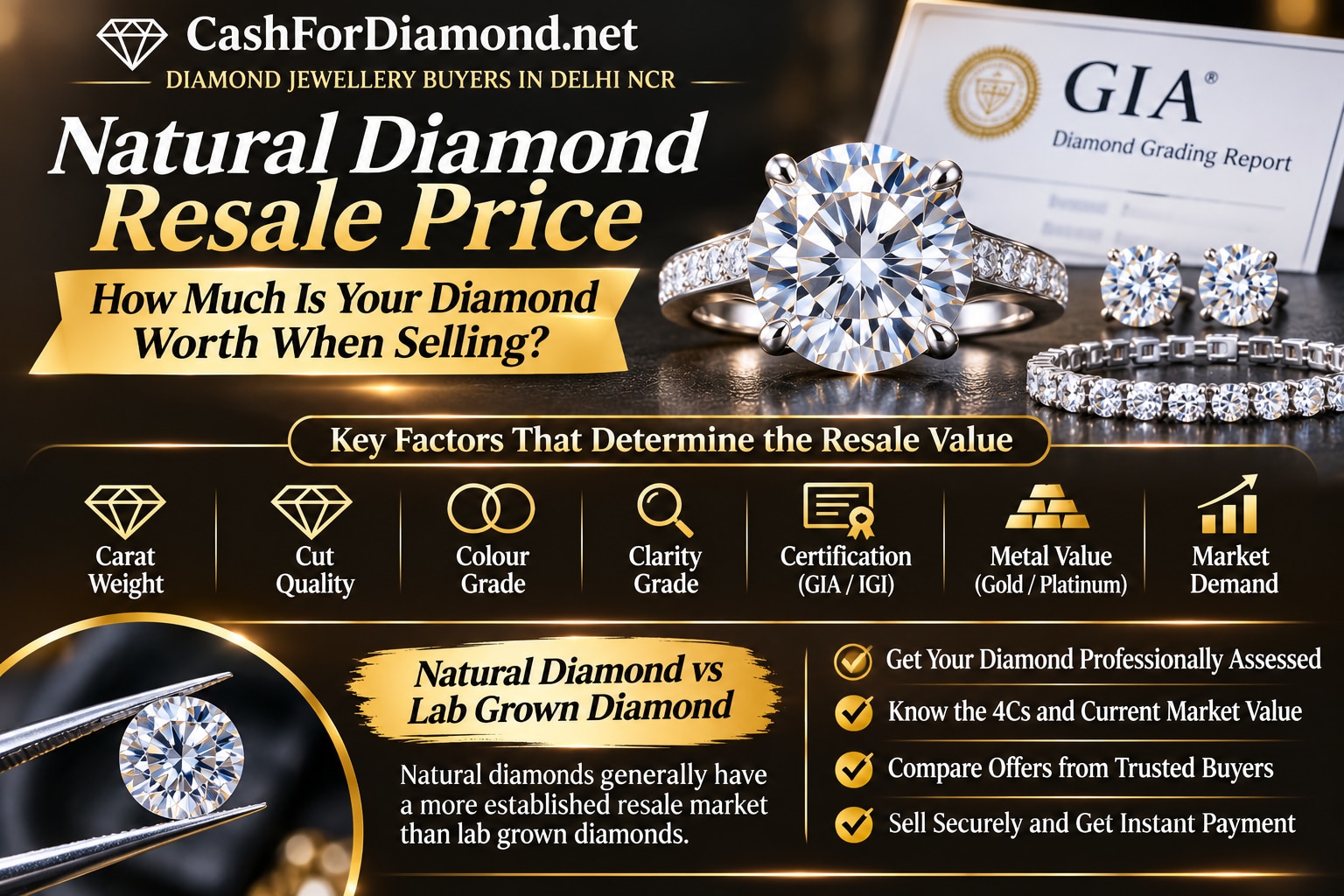
Natural Diamond Resale Price: How Much Is Your Diamond Worth When Selling?
SEO Title: Natural Diamond Resale Price: How Much Is Your Diamond Worth?
Meta Description: Want to know the natural diamond resale price? Learn how carat, cut, colour, clarity, certification and market demand affect the value of old diamonds.
URL Slug: natural-diamond-resale-price
Primary Keyword: Natural Diamond Resale Price
Secondary Keywords:
Natural diamond resale value
Old diamond selling price
Natural diamond buyers near me
Sell natural diamond in Delhi
Diamond ring resale value
Natural diamond price when selling
Cash for diamond
Diamond jewellery resale value
Sell old diamond jewellery
Natural Diamond Resale Price: How Much Is Your Diamond Worth When Selling?
Natural diamonds are valuable gemstones that are often purchased for engagement rings, wedding jewellery, necklaces, earrings and special occasions. However, people sometimes decide to sell their old diamond jewellery because they no longer wear it, want to upgrade their collection or need to understand the resale value of their assets.
One of the most common questions sellers ask is: What is the natural diamond resale price, and how much money can I get when selling my diamond?
The answer depends on several factors. Unlike gold, diamonds do not have one universally applicable resale rate per gram. Their value is assessed according to individual characteristics, certification, condition and the buyer's purchasing requirements.
In this guide, we explain how natural diamond resale value is determined and what you should know before selling your old diamond jewellery.
1. What Is the Resale Price of a Natural Diamond?
The natural diamond resale price is the amount a buyer is willing to offer for a previously owned natural diamond or diamond jewellery.
It is important to understand that the original retail price and the resale price are not necessarily the same.
When you purchase diamond jewellery from a retail showroom, the price may include:
Diamond cost.
Gold or platinum setting.
Jewellery manufacturing and making charges.
Brand or retail margin.
Applicable taxes.
Design and other commercial costs.
When you sell the jewellery, a buyer may assess the diamond and precious-metal components separately. The resale offer depends on the diamond's characteristics and the buyer's ability to resell or otherwise use it.
Therefore, the original purchase bill alone cannot determine the current resale price.
2. What Factors Determine Natural Diamond Resale Value?
Natural diamond valuation generally considers the 4Cs: carat, cut, colour and clarity. Other factors, including certification and market demand, may also influence the offer.
A. Diamond Carat Weight
Carat refers to the weight of a diamond. One carat equals 200 milligrams.
Diamonds are available in different sizes, including:
0.25 carat
0.50 carat
0.75 carat
1 carat
1.50 carat
2 carat
3 carat and above
Larger diamonds may attract different resale interest from smaller stones. However, carat weight alone does not determine the value. Two diamonds with the same carat weight can receive different offers because of differences in cut, colour and clarity.
B. Diamond Cut
Cut describes how well a diamond has been proportioned and finished to interact with light.
A well-cut diamond can display attractive brilliance, fire and sparkle.
Popular diamond shapes include:
Round brilliant.
Princess cut.
Oval cut.
Emerald cut.
Pear shape.
Cushion cut.
Radiant cut.
Cut quality and overall appearance can influence buyer interest and resale potential.
C. Diamond Colour
Diamond colour grading for conventional white diamonds generally evaluates how colourless the stone appears.
The commonly used colour grading scale ranges from D to Z:
D, E and F: Colourless.
G, H, I and J: Near colourless.
K to Z: Increasing degrees of noticeable colour.
Colour grade can influence the resale assessment, although the final offer also depends on the other diamond characteristics and market demand.
D. Diamond Clarity
Clarity refers to internal inclusions and external blemishes in a diamond.
Common clarity grades include:
FL – Flawless.
IF – Internally Flawless.
VVS1 and VVS2 – Very, Very Slightly Included.
VS1 and VS2 – Very Slightly Included.
SI1 and SI2 – Slightly Included.
I1, I2 and I3 – Included.
A diamond's clarity grade is one of the characteristics buyers may consider when assessing its resale potential.
3. Does a Diamond Certificate Increase Its Resale Value?
A diamond grading report from a recognised gemological laboratory can help establish the diamond's specifications.
Reports from laboratories such as GIA and IGI may include information about:
Carat weight.
Colour grade.
Clarity grade.
Measurements.
Cut grade, where applicable.
Diamond identification details.
A certificate can make it easier for a buyer to understand and verify a diamond's characteristics.
However, a grading report does not guarantee a particular resale price. The final offer depends on the stone's current resale potential and the buyer's assessment.
If you have an original diamond certificate, keep it ready when approaching a buyer.
4. Natural Diamond Resale Price vs Original Purchase Price
Many diamond owners expect to receive an amount close to their original purchase price. However, diamond jewellery resale works differently from retail jewellery purchases.
For example, a retail jewellery bill may include the diamond, gold setting, making charges, taxes and retail margins.
A resale buyer may calculate the offer based on:
The assessed natural diamond characteristics.
The diamond's size and quality.
Current demand for comparable diamonds.
Certification and available documentation.
The condition of the diamond and its setting.
The buyer's resale and purchasing policy.
The separate value of the gold or platinum component.
The original making charges, retail margin and taxes are generally not recovered simply because the jewellery is being resold.
It is better to request a fresh assessment rather than assume that the original bill reflects the current resale value.
5. Natural Diamond vs Lab Grown Diamond Resale Price
Natural and lab grown diamonds have essentially the same chemical composition and crystal structure, but they have different origins and market pricing.
Natural diamonds form through geological processes over long periods, while lab grown diamonds are created using technological processes in controlled environments.
Their resale markets can differ significantly.
| Factor | Natural diamond | Lab grown diamond |
|---|---|---|
| Origin | Formed naturally underground | Created in a laboratory |
| Composition | Carbon crystal | Carbon crystal |
| Physical properties | Diamond properties | Essentially the same diamond properties |
| Resale market | Depends on natural diamond demand | Different and generally more limited resale market |
| Resale assessment | Quality, demand and buyer policy | Quality, demand and buyer policy |
Do not assume that natural and lab grown diamonds will receive identical resale offers.
If you are selling a diamond ring or necklace, clearly identify whether the diamonds are natural or lab grown. Buyers may use specialised equipment when necessary to establish the diamond's origin.
6. What Is the Resale Value of a 1 Carat Natural Diamond?
A 1 carat natural diamond can have different resale values depending on its individual characteristics.
For example, two 1 carat diamonds may differ considerably in their:
Cut quality.
Colour grade.
Clarity grade.
Shape.
Certification.
Overall condition.
Market demand.
A 1 carat round brilliant diamond with strong grading characteristics may attract a different offer from a 1 carat diamond with different colour, clarity or cut characteristics.
The same applies to 0.50 carat, 1.50 carat and 2 carat diamonds.
There is no reliable single resale price for every 1 carat natural diamond. A proper assessment is necessary before estimating its value.
7. Can You Sell Natural Diamond Jewellery Without a Certificate?
Yes, some diamond buyers may accept natural diamond jewellery without its original grading certificate.
If you have an old engagement ring, diamond earrings, a necklace or a solitaire without documentation, ask the buyer whether independent assessment is available.
The buyer may examine:
Diamond type.
Approximate or verified carat weight.
Cut and shape.
Colour.
Clarity.
Overall condition.
Available supporting information.
Specialised testing may be needed to establish whether a diamond is natural or lab grown.
A missing certificate does not automatically mean that your diamond has no resale value. However, acceptance and valuation depend on the buyer's assessment process.
8. How Is the Value of Diamond Jewellery Calculated?
If you are selling diamond jewellery rather than a loose diamond, the buyer may assess the precious-metal setting separately.
For example, an 18K gold diamond ring contains two different components:
Diamond component: Assessed according to diamond characteristics and resale potential.
Gold component: Assessed according to verified gold purity, net gold weight and the applicable gold rate.
The total offer may therefore depend on both components.
Ask the buyer:
Is the diamond being valued separately?
How are its specifications established?
Is the gold being weighed separately?
How is the net gold weight calculated?
Are there any deductions or charges?
What is the final payment amount?
A clear valuation breakdown helps you understand how the offer has been calculated.
9. How to Get a Better Understanding of Your Natural Diamond Resale Price
Before selling your diamond jewellery, follow these practical steps.
Step 1: Locate the Original Diamond Certificate
If available, find the original grading report. It may help establish the diamond's specifications.
Step 2: Find the Original Purchase Invoice
The invoice can provide useful information about the original jewellery and its specifications. Remember that it does not guarantee the resale price.
Step 3: Identify the Diamond Type
Confirm whether your diamond is natural or lab grown. This distinction is important because their resale markets differ.
Step 4: Get the Diamond Professionally Assessed
Contact a buyer who has suitable diamond evaluation procedures and ask how the 4Cs and other characteristics are assessed.
Step 5: Ask About the Gold or Platinum Setting
If your diamond is mounted in jewellery, ask whether the metal component is evaluated separately.
Step 6: Compare More Than One Offer
Where possible, contact multiple reputable buyers. Compare the complete valuation rather than looking at one quoted figure alone.
Step 7: Review the Final Terms
Before agreeing to sell, understand all deductions, payment terms and transaction documentation.
10. Where to Sell Natural Diamonds in Delhi NCR?
If you are searching for natural diamond buyers near me, cash for diamond in Delhi or diamond jewellery buyers in Delhi NCR, choose a buyer who explains the assessment process clearly.
People may look for diamond buyers in areas such as:
Kirti Nagar.
Moti Nagar.
Rajouri Garden.
Punjabi Bagh.
Karol Bagh.
Janakpuri.
Dwarka.
Noida.
Gurugram.
Faridabad.
Before visiting, contact the buyer and confirm whether loose natural diamonds, solitaire rings, diamond earrings, necklaces and other jewellery are accepted.
At CashForDiamond.net, you can enquire about diamond jewellery buying services, accepted items and the valuation process.
The business also provides information about assessing the gold and diamond components of old jewellery. Ask for a clear breakdown of the proposed offer before completing a sale.
Frequently Asked Questions About Natural Diamond Resale Price
Q1. What is the resale price of a natural diamond?
There is no fixed resale price for every natural diamond. The offer depends on carat, cut, colour, clarity, certification, condition, market demand and the buyer's purchasing policy.
Q2. Can I sell my natural diamond for the same price I purchased it for?
Not necessarily. The original retail price may include making charges, taxes, brand margins and other costs that are not necessarily recovered during resale.
Q3. How much is a 1 carat natural diamond worth when resold?
The value depends on its cut, colour, clarity, shape, certification and current resale demand. A professional assessment is required to estimate its resale price.
Q4. Does GIA certification help when selling a natural diamond?
A GIA grading report can help establish the diamond's characteristics and make its specifications easier to verify. However, it does not guarantee a particular resale offer.
Q5. Is natural diamond resale value higher than lab grown diamond resale value?
Natural and lab grown diamonds have different resale markets. Natural diamonds generally have a more established resale market, while lab grown diamond resale values are typically more limited. The actual offer depends on the individual diamond and buyer.
Q6. Can I sell a natural diamond without its original bill?
Some buyers may accept diamonds without original purchase invoices. Requirements vary, so confirm the buyer's identification and documentation requirements before visiting.
Q7. Can I sell a natural diamond ring without removing the diamond?
Some buyers can assess a diamond while it remains mounted in its ring. The assessment method depends on the setting and the buyer's equipment and procedures.
Q8. Do diamond buyers pay separately for gold and diamonds?
Some buyers assess the diamond and gold components separately. Ask for a clear breakdown of both valuations before accepting an offer.
Q9. Can I sell old natural diamond earrings or a single diamond earring?
You can enquire with a diamond buyer about selling single earrings, pairs or incomplete jewellery. Acceptance depends on the diamond characteristics and the buyer's purchasing policy.
Conclusion: Understand Your Natural Diamond Resale Price Before Selling
Natural diamonds can have resale value, but the amount you receive depends on much more than carat weight or the original purchase price.
The 4Cs, certification, diamond origin, current market demand and the buyer's assessment all play an important role.
If you own an old natural diamond ring, solitaire, necklace, earrings or loose diamond, get its specifications assessed and compare offers before making a decision.
For diamond jewellery selling enquiries in Delhi NCR, contact CashForDiamond.net to understand the available assessment process.
Cash for Diamond | Natural Diamond Buyers | Diamond Jewellery Resale | Delhi NCR.
Contact Us Today
📍 Location: 69/6A, Main Patel Road, Opp Pillar No 282 Near Kirti Nagar Metro Station, New Delhi 110015, New Delhi
📞 Phone: 9312093120
🌐 Website: www. labdiamondfactory.in
📩 Email: metrostudio1@gmail.com


